Common Surface – Hybrid Work Scheduling Platform
How It Started
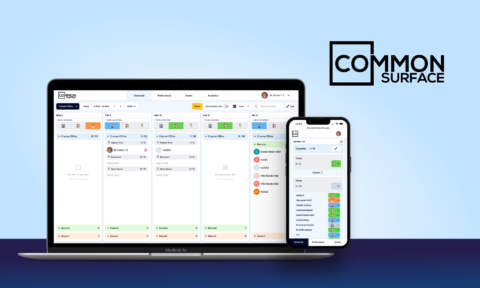
Common Surface came to us with a problem that, at the time, most companies hadn’t yet been forced to think about: how do you coordinate a team that splits its time between the office and home? This was before the pandemic made hybrid working the default – the founder had spotted the problem early and wanted to build a tool to solve it.
The core idea was a scheduling platform that would help employees plan their office days around their teams, colleagues, and available desk space. The founder had already drafted the logic: a small algorithm that would calculate optimal schedules based on employee preferences and office capacity. What was missing was the product around it.
We started with a Design & Discovery phase to translate the algorithm and early concepts into a product roadmap, then moved straight into building the MVP – a functional scheduling tool, delivered in three months with a two-person team.
The Challenge
Three distinct challenges shaped the project, each requiring a different kind of problem-solving.
The scheduling problem was deceptively complex. The original algorithm worked well for simple scenarios – say, a 50-person company with a 40-desk office – but as the product grew, so did the requirements. Employees wanted to coordinate with specific colleagues, account for absences and sick leave, and plan around office events. What started as a straightforward capacity tool had to evolve into a fully interactive scheduling system without losing the simplicity that made it usable.
Calendar integration was the most technically demanding area. We built a bi-directional sync with both Google Calendar and Outlook – meaning the platform could both read from and write to users’ calendars in real time. The difficulty came from rate limits that weren’t clearly documented. When generating a week’s worth of events for a large team, we’d hit API limits after the first hundred or so requests, causing silent failures. Solving this required careful queue management and retry logic to ensure no events were missed or duplicated.
Scaling the team was the third challenge. After the MVP was presented to investors and VC funding came through, the pace changed significantly. The team grew from two developers to thirteen – including developers, QA professionals, and automation testers – and the development process shifted from Kanban to Scrum to match the velocity a funded startup demands.
What We Built
Over nearly three years, Common Surface grew from a scheduling MVP into a comprehensive hybrid work platform with a wide range of integrations.
Scheduling & Office Planning
The core of the platform – employees set their location preferences, and the system generates optimised weekly schedules balancing office capacity, team coordination, and individual preferences. Managers get visibility across the whole company; employees get a clear, simple view of when and where their team will be.
Calendar Sync
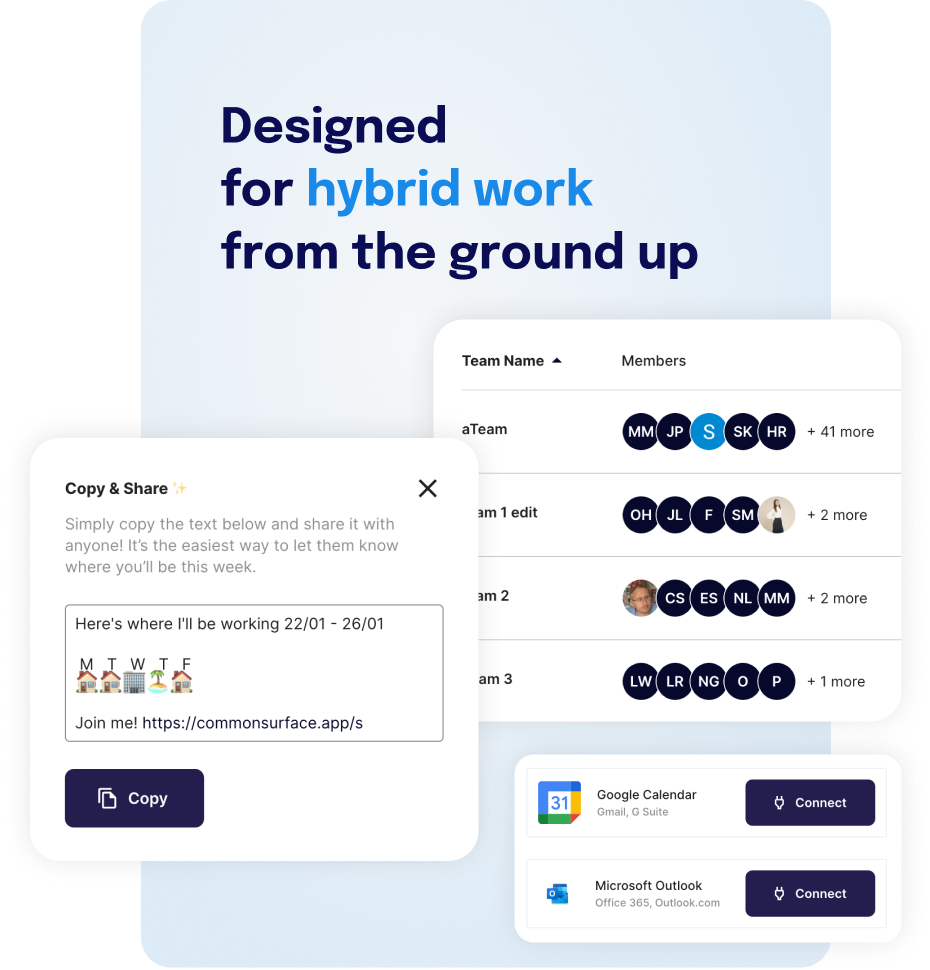
Bi-directional integration with Google Calendar and Outlook keeps work schedules in sync with employees’ personal calendars. Status changes – switching from remote to in-office, marking an absence – are reflected automatically across both systems.
HR Platform Integrations
Integrations with BambooHR, Hibob, and Merge.dev bring absence and leave data directly into the scheduling logic, so the platform always has an accurate picture of who’s available and when.
Slack Integration
A dedicated Slack application lets employees interact with the platform without leaving Slack – checking schedules, updating their status, and receiving notifications directly in their existing workflow.
Analytics & Feature Management
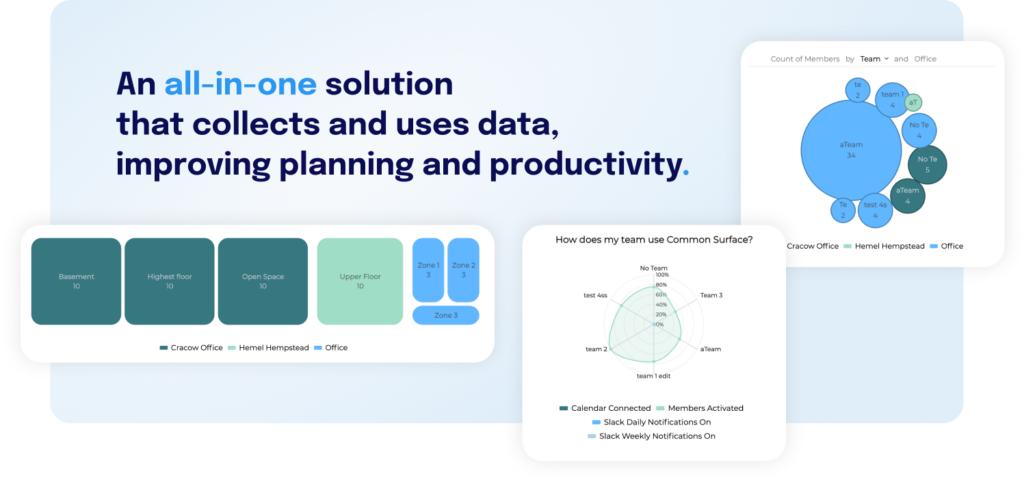
Cumul.io powers the analytics dashboards visible both to users within the platform and to the Common Surface team internally. LaunchDarkly enables controlled feature releases – rolling out new functionality to specific user groups for testing before a full launch.
How We Worked
The project started as a focused two-person engagement and scaled significantly after VC funding came in. At its peak, the THEY.dev team working on Common Surface reached thirteen people. Communication ran through Slack, Jira, and Miro, with one of our founders as the primary point of contact throughout – keeping the relationship direct and decisions fast even as the team grew.
The shift from Kanban to Scrum mid-project was a deliberate response to the pace a funded startup requires – weekly releases, structured sprints, and tight feedback loops with the client’s own developers, data scientists, and product owner.
Technology
The platform is built with Next.js and TypeScript on the frontend, with Java and Node.js powering the backend. MySQL handles data persistence and the infrastructure runs on AWS, with serverless functions via AWS Lambda for scheduled and lightweight tasks, and AWS SQS managing notification queues. OAuth authentication supports both Google and Azure. Intercom handles in-app customer support and onboarding.
Results
Common Surface ran successfully for almost three years – growing from a two-person MVP into a fully featured hybrid work platform serving real teams:
- Delivered a working MVP in three months, which secured VC investment and moved the project into full-scale development.
- Scaled the development team from 2 to 13 people to match the pace of a funded startup without losing delivery quality.
- Built bi-directional calendar sync with Google and Outlook, HR integrations with BambooHR and Hibob, Slack extensions, and a full analytics layer – all shipped iteratively over the course of the engagement.
- All features outlined in the initial estimation were delivered, with additional features added based on user feedback along the way.
All the features that we required in the initial estimation were developed plus a couple of extra ones.
Common Surface Co-Founder
The platform was eventually wound down as competition from major technology platforms intensified – but not before proving the concept, securing investment, and building something that genuinely worked. As the team put it at the time: lessons learned, processes improved, platform built.